
Easy Read in simple words
Easy Read is a way of writing that uses easy words, short Sentences and pictures. It makes Information easier to understand.
An Easy Read Document has one idea in each Sentence, and each Sentence starts on a new line. A picture sits beside the words, to help explain them. The text is large and black, on a white page, with lots of space.
The Easy Read format
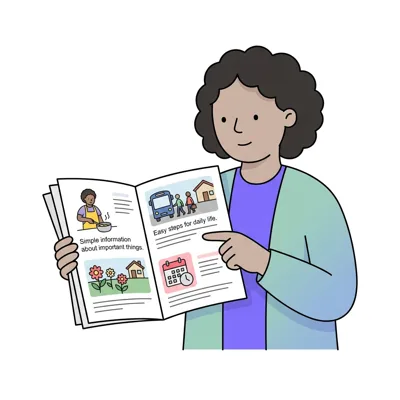
The Easy Read format puts each idea in a row: a picture on the left, and 1 to 3 short Sentences on the right. Headings split the Document into short parts. Hard words are explained, and there is often a list of hard words at the end.
Easy Read text
Easy Read text uses everyday words and the active voice. It talks to the reader as "you". It uses numbers, not words for numbers, and never puts a whole Sentence in capitals or italics.
Who Easy Read helps
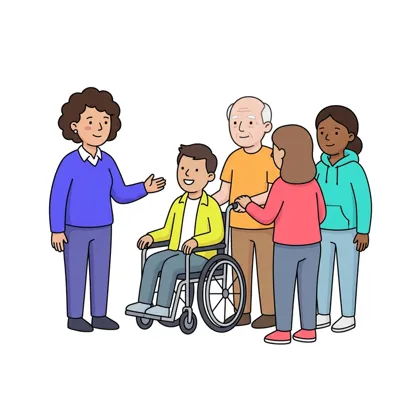
Easy Read is made for people with a learning disability. About 1.5 million people in the UK have a learning disability (Mencap, opens in a new tab). But Easy Read helps many other people too:
- People with a learning disability. Easy Read helps them understand Documents about their health, money and rights.
- Autistic people. Many autistic people prefer clear, direct Information.
- People learning English. Easy words and short Sentences help.
- People with dyslexia, or who find reading hard. About 1 in 6 adults in England have very poor literacy skills (National Literacy Trust, opens in a new tab).
- People who are stressed, ill or busy. When something important is happening, everyone needs clear Information.
Reading hard Sentences takes time and energy. Easy Read lets you think about what the Information means, not about the words. Read why we do not trust reading ages.
Easy Read examples
Example: your data protection rights
Before: hard to read
"Pursuant to the provisions of the Data Protection Act 2018, individuals maintain the prerogative to exercise their statutory rights regarding the processing of their personal data, including but not limited to the right to rectification, erasure, portability, and restriction of processing, subject to applicable exemptions and derogations as specified within the aforementioned legislation."
1 Sentence of 53 words, legal language, and many ideas at once.
After: Easy Read
Your data protection rights
The law says you have rights about your personal information.
You can ask us to:
- fix your information if it is wrong
- delete your information
- give you a copy of your information
- stop using your information.
Example: medicine Information
Before: hard to read
"The patient should discontinue the medication immediately upon experiencing any adverse reactions including but not limited to nausea, dizziness, palpitations, or dermatological manifestations, and should seek immediate medical attention from their healthcare provider or emergency services if symptoms persist or worsen."
After: Easy Read
When to stop taking this medicine
Stop taking this medicine if you:
- feel sick
- feel dizzy
- feel your heart beating fast
- get a rash on your skin.
See a doctor or call 999 if you feel worse.
These 2 examples were written by hand. To see real Claru output, with pictures, try our example letters, or see 3 pages from a Claru Document.
The rules for Easy Read
These are the main rules in the UK Easy Read Standards 2026.
Words
- Use easy words that most people know well, and examples from real life.
- Try not to use jargon. If you must, explain it in plain words, and put the hard word and its meaning in bold.
- Use "you" for the reader, and the same word for the same thing every time.
- Write numbers as figures ("5", not "five"). Write times on the 12-hour clock, and dates in full. Use "1 in 10" or "half", not percentages.
Sentences
- One idea in each Sentence, up to 15 words. Start each Sentence on a new line.
- Use the active voice ("We will send you a letter", not "A letter will be sent").
- Use simple punctuation: no brackets, and no short forms like "can't".
- List 3 or more things as bullet points.
Text
- Black text on a white page, with nothing behind the text.
- A sans-serif font, the same all the way through. Main text about 18 point.
- Text left-aligned. No underlining, italics, shadows or capitals.
The whole Document
- As short as possible: most Documents 20 pages or fewer.
- Every page numbered. At least 1.2 line spacing, and good space between paragraphs.
- At the start, say it is Easy Read and who wrote it. At the end, say where the pictures came from.
- A list of hard words, if there are any.
Pictures
- One picture for each idea, on the left of the words, at least 5cm wide.
- No more than 5 pictures on a page.
- Pictures your readers will understand. Where you can, photos of the real things and people.
- A calendar picture for dates, and a clock picture for times.
Easy Read standards
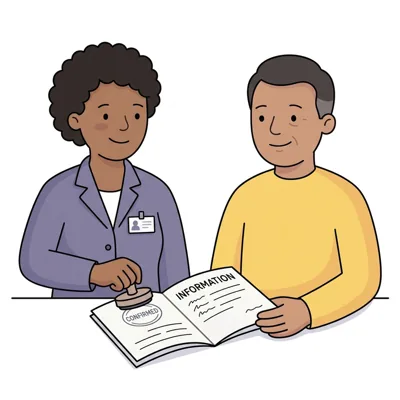
The UK Easy Read Standards 2026 are the first agreed set of rules for making Easy Read in the UK. They were published on 1 October 2026. Claru is a member of the Easy Read Standards Working Group.
Before the Standards, many organisations followed guidance from UKAAF (the UK Association for Accessible Formats), Mencap and others. The Standards bring this guidance together.
There is no certificate, and no register you can join. So any Easy Read provider, including us, can only assess itself.
Testing with readers
The best Easy Read is checked by the people who will read it. We want to be honest: we do not yet test our Documents with people who use Easy Read. A trained Easy Read editor can check your Document, and we are building a panel of Easy Read readers. Join our panel.
Easy Read and the law
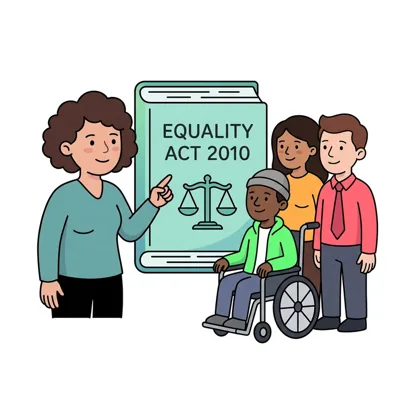
The law does not say every Document must be in Easy Read. But some laws mean organisations must give people Information they can understand:
- The Equality Act 2010: organisations that provide services must make reasonable adjustments for disabled people. Easy Read is often one.
- The Public Sector Equality Duty: public bodies must think about how their work affects disabled people.
- The Accessible Information Standard: NHS and adult social care in England must meet people's Information and communication needs.
- The Care Act 2014: Councils' Information about care must be accessible.
- The Mental Capacity Act 2005: before you decide a person cannot make a decision, you must try to help them, for example with Information they can understand.
Read more about Easy Read and the law. This is a short guide, not legal advice.
When to use Easy Read
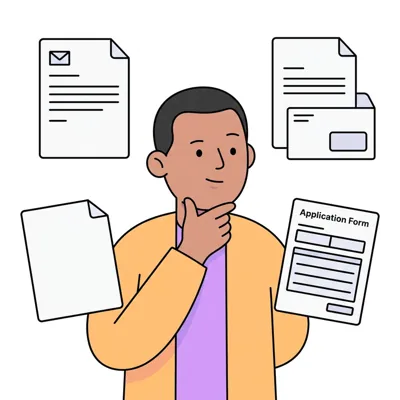
Start with Information that affects people's lives, and anything they must act on. For example:
- Health and care: patient Information, treatment choices, discharge Information, Care Plans, assessments.
- Councils and Government: letters about services, benefits and Council Tax, consultations, voting guides.
- Education: Information about special educational needs and moving schools.
- Housing: Tenancy Agreements, rent letters, repairs.
- Work: job adverts, contracts and workplace Policies.
- Money: bank, insurance and debt letters.
- Charities: service Information and how to get help.
How to make an Easy Read Document
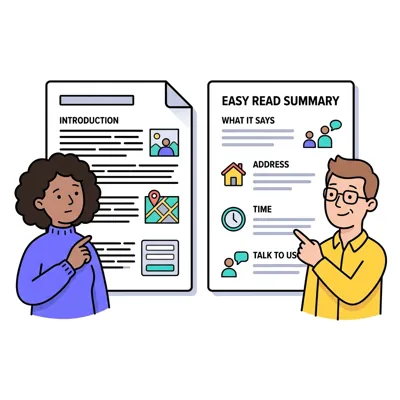
You can write Easy Read yourself, using the rules above. Or you can use an Easy Read service. Easy Read made by hand can cost £290 for 1,000 words, and take 2 to 3 weeks (Disability Equality Scotland's 2026 prices, opens in a new tab).
Easy Read with Claru
-
Upload your Document. It can be a PDF, a Word file or a text file.
-
Check the price and pay: 3p a word, £5 minimum. Your first 1,000 words are free.
-
We email you an Easy Read PDF and Word file, usually in a few minutes. Please read it before you share it.
For important Documents, add Human Post-Editing: a trained Easy Read editor checks every Sentence and picture.
Easy Read and translation
Easy Read uses fewer, simpler words, so it is quicker and cheaper to translate. We plan to make Easy Read in other languages. For help now, see our translation consultancy.
Common questions

What is the difference between Easy Read and Plain English ?
Plain English is clear writing for most adults. Easy Read goes further: shorter Sentences, easier words, bigger text, and a picture for each idea. It is made for people with a learning disability. See the full comparison.
Is Easy Read a legal requirement ?
Not for every Document. But 3 rules matter here: the Equality Act, the Public Sector Equality Duty and the Accessible Information Standard. They mean many organisations must give people Information they can understand. Easy Read is often the answer. Read about Easy Read and the law.
Who sets the rules for Easy Read ?
The UK Easy Read Standards 2026, written by the Easy Read Standards Working Group. Claru is a member of the Working Group.
How long is an Easy Read Document ?
Usually longer than the original, because of the bigger text, pictures and space. The Standards say most Easy Read Documents should be 20 pages or fewer. Claru tells you before you start if your Document is likely to be long.
Where can I find more Easy Read resources ?
Mencap (opens in a new tab) has Easy Read resources and research. UKAAF (opens in a new tab) has guidance on accessible formats.